Here is an uncomfortable number. Going into 2026, the Edelman Trust Barometer found trust in technology companies falling worldwide, and trust in U.S. tech now runs roughly 30 points behind trust in China's. Not behind Europe's. Behind China's.
I have spent 25 years building technology systems in 15 countries, for companies like Honeywell and Schneider Electric, and I have never seen the map move this fast. The question in every boardroom I sit in, from Dallas to Libreville, is no longer “which U.S. platform do we buy?” It is “how much of our future are we willing to rent from a country we no longer fully trust?”
That question has a name now: sovereign AI. Sovereign AI means a nation or a business owns the intelligence it runs on: the models, the hardware they live on, the data they learn from, and the power to keep them running no matter what a vendor or a foreign government decides. Watch what the world is doing about it, region by region, and the pattern is impossible to miss.
Europe is building its exit
In January, the European Parliament voted 471 to 68 to begin unwinding its dependence on foreign technology. The numbers behind that vote explain it. Three U.S. companies hold about 70 percent of Europe's cloud market. The EU depends on non-EU providers for more than 80 percent of its digital products and services. One member of parliament put it bluntly: without action, Europe risks becoming a digital colony.
And the politics underneath are combustible. This fall, cost-of-living protests swept European capitals, led by young people squeezed between flat wages and rising prices. In Italy, thousands marched against the cost of living and arms spending in the same breath. A strained, angry Europe is exactly the Europe that stops buying American by default.
The parliament's vote is non-binding. The direction is not. Gartner found that 61 percent of Western European CIOs already plan to shift workloads toward local providers. Europe will take a decade to get there. It has decided to start.
Canada walked into the room the U.S. left
Here is the development Americans are not watching. Canada, our next-door neighbor, is quietly doing the convening the United States used to do. In February, Canada and Germany launched the Sovereign Technology Alliance at the Munich Security Conference. In June, Prime Minister Carney's government shipped a national AI strategy with sovereign compute at its center and twelve international AI partnerships already signed, from the EU to India to the Gulf. Canada's AI minister summed up the posture in five words: “Canada and Germany are choosing to build.”
When middle powers need a trusted partner on AI, they are finding one. It is just not us.
China is not selling. It is giving.
China understood something Washington has not: in most of the world, the barrier to AI is price and permission. So China removed both. Its best open models now sit within a generation of U.S. frontier systems, and the weights are free to download, free to run on your own hardware, free from an export officer's mood. Beijing wrapped that with patient diplomacy: a Global AI Governance plan offering capacity-building to developing countries, and a new world AI cooperation body headquartered in Shanghai. Chinese labs are pitching “sovereign AI agents” to governments across the Belt and Road.
And China is rebuilding its own house to match. Between 2021 and 2025, Beijing cut 12,200 university degree programs, more than 30 percent of everything its universities offered, and replaced them with AI, robotics, semiconductor engineering, and data science. Agree or disagree with the method, that is a nation redesigning its education system around the future instead of defending the past.
Call the diplomacy odd. It is working, because it answers the question the customer is actually asking: will this still be mine tomorrow?
The watchers: Latin America and Africa
Latin America is watching closely, and efficiently. Brazil just split $444 million in AI infrastructure between the two camps: a supercomputing center in Rio with Huawei and iFlytek, and a second machine expected to run on Nvidia. Brasília said the strategy out loud: depend on no single company, technology, or country. That is not confusion. That is discipline.
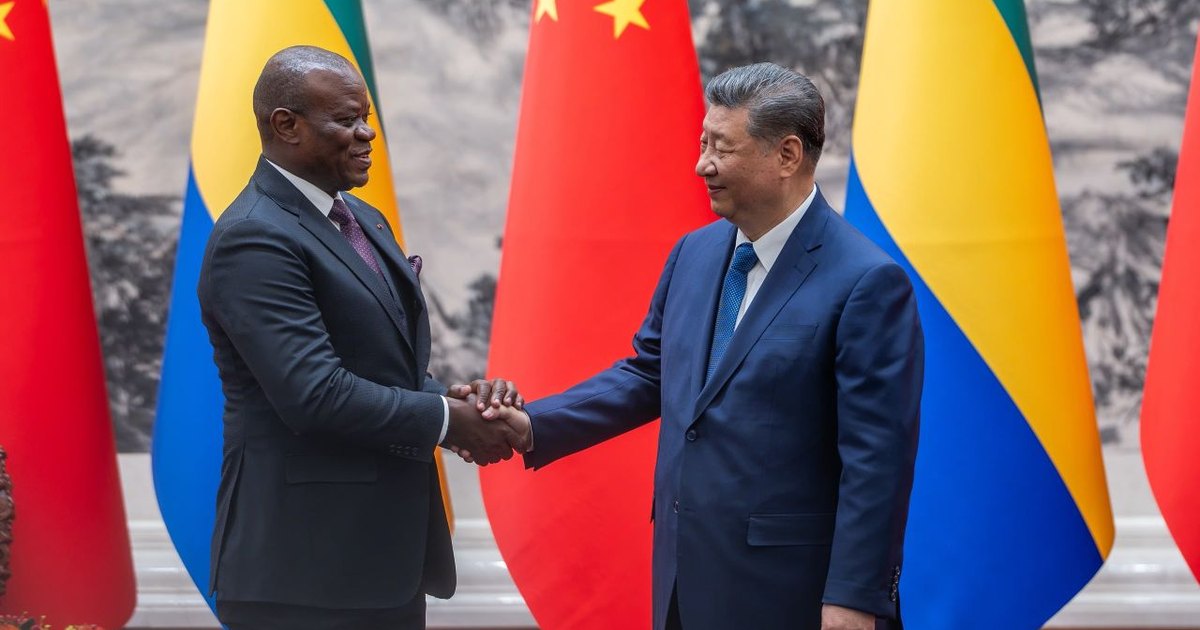
And Africa, the fastest-growing digital market on earth, is the one the U.S. has most thoroughly neglected. I co-chair the American Business Council in Gabon, I serve clients across the continent, and I can tell you what the room looks like: Chinese infrastructure is present, priced, and committed, while U.S. engagement is a webinar and a wait-and-see. The continent that will hold a quarter of humanity by 2050 is choosing its technology partners right now. We are mostly not in the bidding.
The message we send from home
Why does the world doubt us? Because before the world judges a country's exports, it judges how that country treats its own people. And on that score, we are telling a story no diplomat can spin.
Start with healthcare. Roughly two out of three personal bankruptcies in the United States involve medical bills. Think about what that means. You can work your whole life in the wealthiest country in history, serve it honestly, and the month you lose your job, one hospital stay can erase everything you built. No other advanced nation does this to its people. The world knows it, because their citizens who studied here went home and told them.
Meanwhile we spend a defense budget approaching a trillion dollars a year, on top of the roughly eight trillion dollars that Brown University's Costs of War project counts for the post-9/11 wars. I am not naive about security. I am saying what every operator knows: resources follow priorities, and our priorities are visible from every capital on earth.
Education tells the same story. The world used to send us its brightest because our universities were the destination. Last fall, new international student enrollment dropped 17 percent, driven by our own visa policies. We are not being beaten. We are withdrawing. While China rebuilds a third of its university system around AI, we are turning away the people who wanted to build here.
Even our own technology boom is sending a double message. AI is being embraced across every industry, from medicine to manufacturing to law. Yet U.S. tech companies cut nearly 200,000 workers in 2026 while spending record sums on AI infrastructure. The gains are real. The question the world asks is the same one our own workers ask: gains for whom?
Then look at what serious small countries do. Singapore opens a savings account for every newborn and co-funds it, dollar for dollar, so every child starts life with assets, while its healthcare system keeps its people out of bankruptcy. A city-state of six million understands something a superpower has forgotten: taking care of your existing generation while investing in the next one is not welfare. It is strategy. It is the most convincing export a nation has.
Something has to change. Not because it is charitable, but because credibility begins at home. A country where a hospital bill can bankrupt a working family cannot lecture the world about trust.
What is left for the U.S.
Still a great deal. The deepest capital markets, the best research labs, the strongest brands, and something no rival can copy: the world still wants to believe in us. The 30-point trust gap is not a verdict on U.S. technology. It is a verdict on American follow-through.
But let me be honest about the clock, because anyone who tells you the U.S. can simply snap the old order back is selling you something. It may already be too late to reassert the leadership we had. The next set of American leaders will inherit a vastly changed world: a Europe that has voted to build its own stack, a Canada that convenes the alliances we used to, a China whose models run free on five continents, and a Global South that learned to buy from both sides and bow to neither. That world will not hand back the deference it spent a decade withdrawing. The old seat at the head of the table is gone. What is still winnable is the most trusted seat at a bigger table, and even that has a closing window.
On November 3, Americans elect a new House and a new Senate. I am not telling anyone how to vote, and this is not about one party. It is about what the 120th Congress does in its first hundred days. The new House and the new Senate must embrace the AI challenge the way an earlier Congress embraced the space race: a real national AI strategy, export programs that actually ship, open American models the world can hold, and a visible U.S. presence in Lagos, Nairobi, São Paulo, and Libreville, not just in Brussels when there is a dispute. And it must put the home front inside that strategy, because they are the same project: move real resources from wars we did not need toward the two assets that built American prestige in the first place, healthy citizens and an education system the world lines up to join.
The world is watching that election for one signal only: can the United States still act?
I am an immigrant. I chose this country on the bet that it can. I built my company here on the same conviction I offer my clients: own your technology, keep your data, control your future. That is what sovereignty means for a business, and it is what leadership means for a nation.
The world stopped waiting for the United States. It has not stopped watching, yet. The next two years decide whether it ever looks back.
Get the next piece first.
One email when I publish. Field notes on AI, Africa, Haiti, and running a business across borders. No spam, and you can leave anytime.
Your email is only used to send new writing. Reply to any email to unsubscribe.
If this piece sharpened a thought for you, send it to someone who’d benefit from the same sharpening.
- 1.Semafor: trust in tech companies dropped globally in 2026 (Edelman Trust Barometer)
- 2.European Parliament resolution of 22 January 2026 on technological sovereignty and digital infrastructure
- 3.Gartner: geopolitics will drive 61% of Western European CIOs to rely more on local cloud providers
- 4.Government of Canada: Canada and Germany sign AI joint declaration and launch the Sovereign Technology Alliance
- 5.South China Morning Post: China's universities cut 12,000 obsolete degrees in the race to embrace AI
- 6.Al Jazeera: Brazil launches AI supercomputer push while balancing U.S. and Chinese tech
- 7.Becker's Hospital Review: medical debt a factor in two-thirds of bankruptcies (American Journal of Public Health)
- 8.Brown University Costs of War project: post-9/11 wars cost more than $8 trillion
- 9.NBC News: new international student enrollment fell 17% (Open Doors fall snapshot)
- 10.TechRepublic: tech layoffs in 2026 affect about 196,000 workers